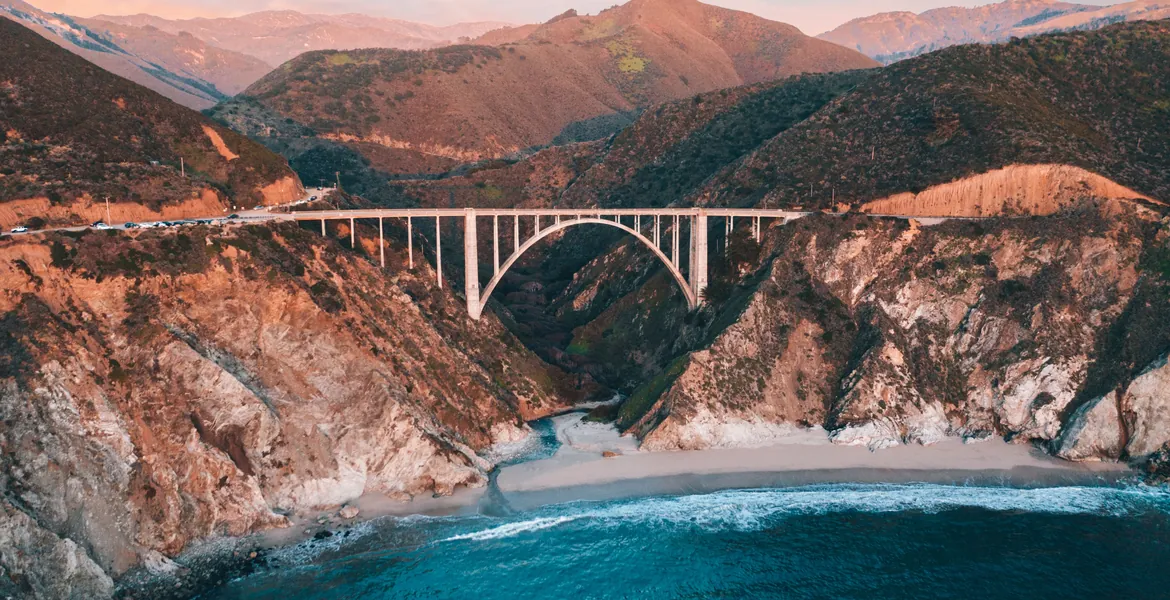
the screensaver
It feels like the Truman Show. Except the horror is not the set imagined around me. My backyard was mined for ambiance.
I was sitting in a whole other country, staring at a factory default screensaver, and the slideshow was my childhood. The first slide, a semi-obscure Big Sur bridge, the one from a first fully formed memory. Then the only wooden roller coaster from a small but extremely familiar beach town. Finally the distinctive pyramid shaped office building where I initially paid rent in 'the city'. Also too, of course, there was the Golden Gate, Baker Beach on the non-suicide side if you want the local joke, cide swallowed into side and nobody notices they're the same word doing different work, but then Treasure Island and the Bay Bridge, the place where I nearly got blown off the upper deck in ridiculous winds. This isn't a personal image stack configured for this tv in particular. This is globalization writ large, the silicon explosion that blew valley culture all the way down the coast into Trujillo and likely the rest of the world.
Don't change the defaults on your TV and you can see how I grew up. The famous Victorian ladies from Full House sit next to majestic redwoods and familiar coastlines. So many touchpoints for an aesthetic metastasized out of my memories. What I'm less sure about is whether the shock is unique to me or whether everyone, eventually, finds their own geography flattened into someone else's wallpaper, I suspect the latter, but I might be wrong about the scale.
Steinbeck's Salinas and Santa Cruz were already being mined and refigured as fiction's California in East of Eden, where the blackmailer hides out, before Hollywood or TV ever touched them. That factory-default moment seems like just the latest, most denuded iteration of a strip-mining practice that started with literature, got industrialized by film and television, and is now fully automated down to factory-default wallpaper with no visible fingerprints at all. Sicario does it to the concrete overpasses of Juárez. Narcos does the same to Medellín's skyline. Specific, living cities, stripped to genre mood - the pattern is still active.
My semi-obscure Bixby bridge flashes past in a stranger's screensaver the same way Santa Cruz name drops into East of Eden and Medellín 'adds colour' to that Netflix series, processed, denuded, circulating on its own, no longer needing the people who were actually from there. The computer became a mirror instead of a stage, and after two decades of performance, that glass surface is a relief. But the ease is made of other people's memories, polished until the grain disappears. You are not the protagonist. You're just from where they went looking once the real material ran out.