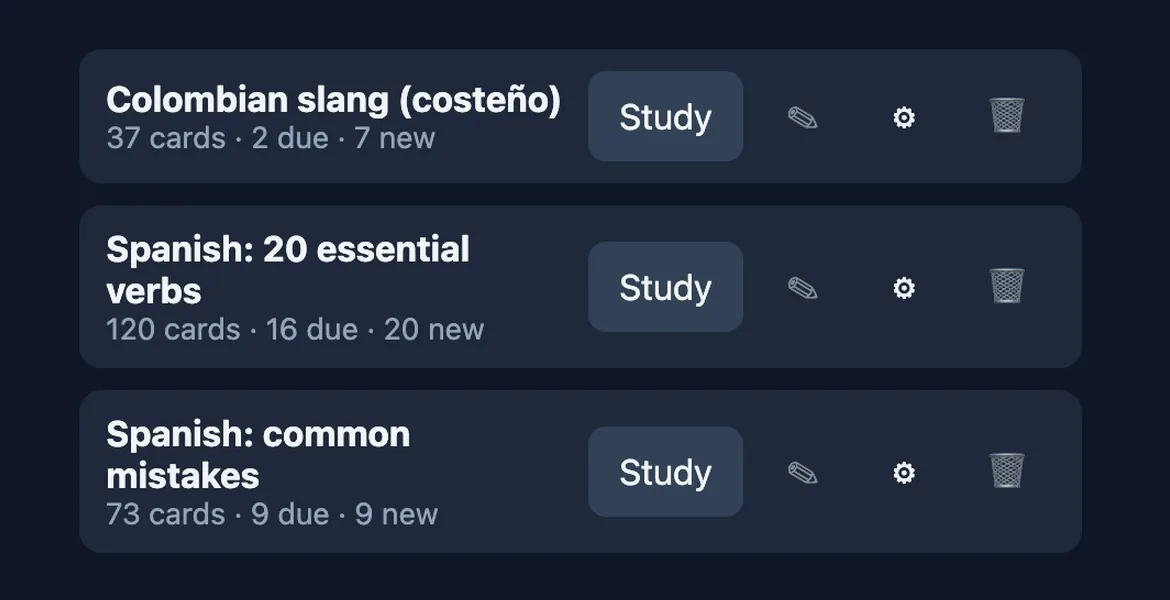
the deck that made us fight
There is a deck now of my common Spanish mistakes. I built it from my own WhatsApp messages and studyable on Recall71. You can see it here under the starter decks, where it shows up as "Spanish: common mistakes," or grab the Anki file directly. Seventy plus cards and I'm failing more than half of them revealing real gaps.
Before this this I made a Colombian slang deck, costeño, the public version of which carries mild parental advisory and the line "Explicit language." Honest of it. I built my very own 40 card variant to understand the lava flow from a certain Costeña when angry, a sentence I stand by. The theory was that if I knew the vocabulary I could hold my smoldering footing in the current instead of being swept away myself.
It worked, and that was the problem.
The old arrangement was that incomprehension blanketed the worst of it. Sarcasm reads as white noise. But now I understand it. The signal arrives clean, and a clean signal cuts.
Her from two doors down, apagame los frijoles porfi? Me closing the distance till I can abrigo and the shade closes over her eyes.
We get along worse the better my Spanish gets, and I don't have a resolution for that, only the observation that understanding a thing is not the same as surviving it. The specific failure this deck is best at is mine: I pose questions as commands. Not "could you," just the imperative, dropped flat, and in Spanish that lands poorly. More fluency would delete an entire class of misunderstanding. But I'm stuck at the stage where I've enough ear for nuance to hear that something is wrong and not enough to have said it right.
There's a starter deck on the site called "Spanish past tense: a terrible Saturday," twenty verbs told as one disastrous day with a picture and a spoken clip per scene, a bad day used as the memory hook. Mine is the same device pointed at all the bad days, except the days are ongoing.
I exported the chat, about 6,500 lines, into a folder git forgets. A script keeps only my own messages, around 1,600 of them, and feeds them in batches to a Qwen 9B running four-bit on the Mac through mlx_lm. Nothing left the machine. The model hands back short structured records: the wrong form, the correction, a category, a one-line reason. It is enthusiastic to a fault. Flagging nearly one error per message, most of them missing accents, and it disagrees with itself between runs, so a pair only counts if two differently-shuffled passes both catch it. On a test sentence it caught the gender slip and picked out "embarazada" meaning pregnant and not embarrassed, then missed an unaccented "compre" in one phrasing and found it in the next. Two passes of a local model agreeing is still not proof.
I dropped the spelling and accent noise on purpose. My US keyboard has no ñ and no accented vowels, so a missing tilde is hardware and apathy, not a gap in language that matters to me. What's left is the real stuff: verb forms, gender, false friends, ser and estar, the prepositions I guess at. "Returnir" just isn't a word, no matter how much I insist.
Here's the honest provenance, or what I think passes for honest. The mining supplied the topics, not the cards. Every card was written fresh, an English prompt, the right Spanish, a rule, three wrong choices, and no native speaker has checked any of it, so you're drilling against an AI's best guess corrected by a man who fails the deck. The cards were written from scratch, which means no origin message text is surfaced. Not a sentence, not a fight, nothing a stranger could reassemble. The corpus pointed out my blind spots. What ships is only the outline of my errors.
What the deck fixes is how I speak. It does nothing whatsoever about how I read her or the fracturas she hears or she sees in my face. Reading was the thing that broke. So I keep practicing the things I've gotten wrong for a year, and somehow it frames a thought, one I'm not sure how to respond to, whether better Spanish was even the thing that needed fixing.